What follows is a brief explanation of Dr. Bob Utley’s hermeneutical philosophy and the
procedures used in his commentaries.
Guide to Good Bible Reading Video -- 40 min.
1. Can we know truth?
2. Where is it found?
3. Can we logically verify it?
4. Is there an ultimate authority?
5. Are there absolutes which can guide our lives, our world?
6. Is there meaning to life?
7. Why are we here?
8. Where are we going?
These questions—questions that all rational people
contemplate—have haunted the human intellect since the beginning of time (Eccl. 1:13-18; 3:9-11).
I can remember my personal search for an integrating center for my life. I became a believer in Christ at a
young age, based primarily on the witness of significant others in my family. As I grew to adulthood,
questions about myself and my world also grew. Simple cultural and religious clichés did not bring meaning
to the experiences I read about or encountered. It was a time of confusion, searching, longing, and often a
feeling of hopelessness in the face of the insensitive, hard world in which I lived.
Many claimed to have answers to these ultimate questions, but after
research and reflection I found that their answers were based upon
1. personal philosophies
2. ancient myths
3. personal experiences
4. psychological projections
I needed some degree of verification, some evidence, some rationality on which to base my
worldview, my integrating center, my reason to live.
I found these in my study of the Bible. I began to search for evidence of its trustworthiness, which I found in
1. the historical reliability of the Bible as confirmed by archaeology
2. the accuracy of the historical prophecies of the Old Testament
3. the unity of the Bible message over the sixteen hundred years of its production
4. the personal testimonies of people whose lives had been permanently changed
by contact with the Bible. See five lectures on the trustworthiness of the Bible on my homepage
(www.freebiblecommentary.org)
in the first paragraph. Click on link.
Christianity, as a unified system of faith and belief, has the ability to deal with complex questions of human life.
Not only did this provide a rational framework, but the experiential aspect of biblical faith brought me emotional joy and stability.
I thought that I had found the integrating center for my life—Christ, as understood
through the Scriptures. It was a heady experience, an emotional release. However, I can still remember the shock and pain when
it began to dawn on me how many different interpretations of this book were advocated, sometimes even within the same
churches and schools of thought. Affirming the inspiration and trustworthiness of the Bible was not the end, but only the beginning.
How do I verify or reject the varied and conflicting interpretations of the many difficult passages in Scripture by those who were
claiming its authority and trustworthiness?
This task became my life’s goal and pilgrimage of faith. I knew that my faith in Christ had
1. brought me great peace and joy. My mind longed for some absolutes in the midst of the
relativity of my culture
2. the dogmatism of conflicting religious systems (world religions)
3. denominational arrogance
In my search for valid approaches to the interpretation of ancient literature, I was surprised to discover my
own historical, cultural, denominational and experiential biases. I had often read the Bible simply to reinforce my own views.
I used it as a source of dogma to attack others while reaffirming my own insecurities and inadequacies. How painful this realization was to me!
Although I can never be totally objective, I can become a better reader of the Bible. I can
limit my biases by identifying them and acknowledging their presence. I am not yet free of them, but I have confronted my own
weaknesses. The interpreter is often the worst enemy of good Bible reading!
Let me list some of the presuppositions I bring to my study of the Bible so that you, the reader,
may examine them along with me:
I. Presuppositions
- I believe the Bible is the sole inspired self-revelation
of the one true God. Therefore, it must be interpreted in
light of the intent of the original divine author through a
human writer in a specific historical setting.
- I believe the Bible was written for the common
person—for all people! God accommodated Himself to speak to
us clearly within a historical and cultural context. God
does not hide truth—He wants us to understand! Therefore, it
must be interpreted in light of its day, not ours. The Bible
should not mean to us what it never meant to those who first
read or heard it. It is understandable by the average human
mind and uses normal human communication forms and
techniques.
- I believe the Bible has a unified message and purpose.
It does not contradict itself, though it does contain
difficult and paradoxical passages. Thus, the best
interpreter of the Bible is the Bible itself.
- I believe that every passage (excluding prophesies) has
one and only one meaning based on the intent of the
original, inspired author. Although we can never be
absolutely certain we know the original author’s intent,
many indicators point in its direction:
- the genre (literary type) chosen to express the
message
- the historical setting and/or specific occasion that
elicited the writing
- the literary context of the entire book as well as
each literary unit
- the textual design (outline) of the literary units as
they relate to the whole message
- the specific grammatical features employed to
communicate the message
- the words chosen to present the message
The study of each of these areas becomes the object of our
study of a passage. Before I explain my methodology for good
Bible reading, let me delineate some of the inappropriate
methods being used today that have caused so much diversity of
interpretation, and that consequently should be avoided:
II. Inappropriate Methods
- Ignoring the literary context of the books of the Bible
and using every sentence, clause, or even individual words
as statements of truth unrelated to the author’s intent or
the larger context. This is often called "proof-texting.”
- Ignoring the historical setting of the books by
substituting a supposed historical setting that has little
or no support from the text itself.
- Ignoring the historical setting of the books and reading
it as the morning hometown newspaper written primarily to
modern individual Christians.
- Ignoring the historical setting of the books by
allegorizing the text into a philosophical/theological
message totally unrelated to the first hearers and the
original author’s intent.
- Ignoring the original message by substituting one’s own
system of theology, pet doctrine, or contemporary issue
unrelated to the original author’s purpose and stated
message. This phenomenon often follows the initial reading
of the Bible as a means of establishing a speaker’s
authority. This is often referred to as "reader response”
("what-the-text-means-to-me” interpretation).
At least three related components may be found in all
written human communication:

In the past, different reading techniques have focused on
one of the three components. But to truly affirm the unique
inspiration of the Bible, a modified diagram is more
appropriate:
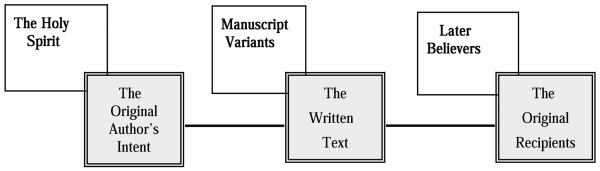
In truth all three components must be included in the interpretive process. For the purpose of verification, my
interpretation focuses on the first two components: the original author and the text. I am probably reacting to the abuses I have observed
1. allegorizing or spiritualizing texts
2. "reader response” interpretation (what-it-means-to-me)
Abuse may occur at each stage. We must always check our motives, biases, techniques,
and applications. But how do we check them if there are no boundaries to interpretations, no limits, no criteria? This is where
authorial intent and textual structure provide me with some criteria for limiting the scope of possible valid interpretations. Hermeneutics
cannot always tell you what a text means, but it can tell you what it cannot mean!
In light of these inappropriate reading techniques, what are some possible approaches to good
Bible reading and interpretation which offer a degree of verification and consistency?
III. Possible Approaches to Good Bible Reading
At this point I am not discussing the unique techniques of
interpreting specific genres but general hermeneutical
principles valid for all types of biblical texts. A good book
for genre-specific approaches is How To Read The Bible For All
Its Worth, by Gordon Fee and Douglas Stuart, published by
Zondervan.
My methodology focuses initially on the reader allowing the
HolySpirit to illumine the Bible through four personal reading
cycles. This makes the Spirit, the text and the reader
primary, not secondary. This also protects the reader from
being unduly influenced by commentators. I have heard it said:
"The Bible throws a lot of light on commentaries.” This is not
meant to be a depreciating comment about study aids, but
rather a plea for an appropriate timing for their use.
We must be able to support our interpretations from the text
itself. Five areas provide at least limited verification:
- historical setting
- literary context
- grammatical structures (syntax)
- contemporary word usage
- relevant parallel passages
- genre
We need to be able to provide the reasons and
logic behind our interpretations. The Bible is our only
source for faith and practice. Sadly, Christians often
disagree about what it teaches or affirms. The four reading
cycles are designed to provide the following interpretive
insights:
- The first reading cycle
- Read the book in a single sitting. Read it again in a different translation, hopefully from a different translation theory
(1) word-for-word (NKJV, NASB, NRSV)
(2) dynamic equivalent (TEV, JB)
(3) paraphrase (Living Bible, Amplified Bible)
- Look for the central purpose of the entire writing. Identify its theme.
- Isolate (if possible) a literary unit, a chapter, a paragraph or a sentence which clearly expresses this central purpose or theme.
- Identify the predominant literary genre
(1) Old Testament
a) Hebrew narrative
b) Hebrew poetry (wisdom literature, psalm)
c) Hebrew prophecy (prose, poetry)
d) Law codes
(2) New Testament
a) Narratives (Gospels, Acts)
b) Parables (Gospels)
c) Letters/epistles
d) Apocalyptic literature
- The second reading cycle
- Read the entire book again, seeking to identify major topics or subjects.
- Outline the major topics and briefly state their contents in a simple statement.
- Check your purpose statement and broad outline with study aids.
- The third reading cycle
- Read the entire book again, seeking to identify the historical setting and specific occasion for the writing
from the Bible book itself.
- List the historical items that are mentioned in the Bible book
(1) the author
(2) the date
(3) the recipients
(4) the specific reason for writing
(5) aspects of the cultural setting that relate to the
purpose of the writing
(6) references to historical people and events
- Expand your outline to paragraph level for that part of the biblical book you are interpreting. Always identify and
outline the literary unit. This may be several chapters or paragraphs. This enables you to follow the original author’s
logic and textual design.
- Check your historical setting by using study aids.
- The fourth reading cycle
- Read the specific literary unit again in several translations
(1) word-for-word (NKJV, NASB, NRSV)
(2) dynamic equivalent (TEV, JB)
(3) paraphrase (Living Bible, Amplified Bible)
- Look for literary or grammatical structures
(1) repeated phrases, Eph. 1:6,12,14
(2) repeated grammatical structures, Rom. 8:31
(3) contrasting concepts
- List the following items
(1) significant terms
(2) unusual terms
(3) important grammatical structures
(4) particularly difficult words, clauses, and sentences
- Look for relevant parallel passages
(1) look for the clearest teaching passage on your subject using a) "systematic theology” books b) reference Bibles
c) concordances
(2) look for a possible paradoxical pair within your subject. Many biblical truths are presented in dialectical pairs; many
denominational conflicts come from proof-texting half of a biblical tension. All of the Bible is inspired, and we must
seek out its complete message in order to provide a Scriptural balance to our interpretation.
(3) look for parallels within the same book, same author or same genre; the Bible is its own best interpreter because
it has one author, the Spirit.
- Use study aids to check your observations
of historical setting and occasion
(1) study Bibles
(2) Bible encyclopedias, handbooks and dictionaries
(3) Bible introductions
(4) Bible commentaries (at this point in your study, allow the believing community, past and present, to aid and correct
your personal study.)
IV. Application of Bible Interpretation
At this point we turn to application. You have taken the time
to understand the text in its original setting; now you must
apply it to your life, your culture. I define biblical
authority as "understanding what the original biblical author
was saying to his day and applying that truth to our day with the same power.”
Application must follow interpretation of the original
author’s intent both in time and logic. We cannot apply a
Bible passage to our own day until we know what it was saying
to its day! A Bible passage should not mean what it never
meant!
Your detailed outline, to paragraph level (reading cycle #3),
will be your guide. Application should be made at paragraph
level, not word level. Words have meaning only in context;
clauses have meaning only in context; sentences have meaning
only in context. The only inspired person involved in the
interpretive process is the original author. We only follow
his lead by the illumination of the Holy Spirit. But
illumination is not inspiration. To say "thus saith the Lord,”
we must abide by the original author’s intent. Application
must relate specifically to the general intent of the whole
writing, the specific literary unit and paragraph level
thought development.
Do not let the issues of our day nor denominational distinctives interpret the Bible; let the
Bible speak! This may require us to draw principles from the
text. This is valid if the text supports a principle.
Unfortunately, many times our principles are just that, "our”
principles—not the text’s principles.
In applying the Bible, it is important to remember that
(except in prophecy) one and only one meaning is valid for a
particular Bible text. That meaning is related to the intent
of the original author as he addressed a crisis or need in his
day. Many possible applications may be derived from this one
meaning. However, the application will be based on the modern recipients’
needs but must be related to the original author’s meaning.
V. The Spiritual Aspect of Interpretation
So far I have discussed the logical process involved in
interpretation and application. Now let me discuss briefly the
spiritual aspect of interpretation. The following checklist
has been helpful for me:
- Pray for the Spirit’s help every time we open the Bible (cf. I Cor. 1:26-2:16).
- Pray for personal forgiveness and cleansing from known
sin (cf. I John 1:9).
- Pray for a greater desire to know God (cf. Ps. 19:7-14;
42:1ff.; 119:1ff).
- Apply any new insight immediately to your own life.
- Remain humble and teachable.
It is so hard to keep the balance between the logical
process and the spiritual leadership of the Holy Spirit. The
following quotes have helped me balance the two:
- from James W. Sire, Scripture Twisting, pp. 17-18:
"The illumination comes to the minds of God’s people—not
just to the spiritual elite. There is no guru class in
biblical Christianity, no illuminati, no people through whom
all proper interpretation must come. And so, while the Holy
Spirit gives special gifts of wisdom, knowledge and
spiritual discernment, He does not assign these gifted
Christians to be the only authoritative interpreters of His
Word. It is up to each of His people to learn, to judge and
to discern by reference to the Bible which stands as the
authority even to those to whom God has given special
abilities. To summarize, the assumption I am making
throughout the entire book is that the Bible is God’s true
revelation to all humanity, that it is our ultimate
authority on all matters about which it speaks, that it is
not a total mystery but can be adequately understood by
ordinary people in every culture.”
- on Kierkegaard, found in Bernard Ramm, Protestant
Biblical Interpretation, p. 75:
According to Kierkegaard the grammatical, lexical, and
historical study of the Bible was necessary but preliminary
to the true reading of the Bible. "To read the Bible as
God’s word one must read it with his heart in his mouth, on
tip-toe, with eager expectancy, in conversation with God. To
read the Bible thoughtlessly or carelessly or academically
or professionally is not to read the Bible as God’s Word. As
one reads it as a love letter is read, then one reads it as
the Word of God.”
- H. H. Rowley in The Relevance of the Bible, p. 19:
"No merely intellectual understanding of the Bible, however
complete, can possess all its treasures. It does not despise
such understanding, for it is essential to a complete
understanding. But it must lead to a spiritual understanding
of the spiritual treasures of this book if it is to be
complete. And for that spiritual understanding something
more than intellectual alertness is necessary. Spiritual
things are spiritually discerned, and the Bible student
needs an attitude of spiritual receptivity, an eagerness to
find God that he may yield himself to Him, if he is to pass
beyond his scientific study unto the richer inheritance of
this greatest of all books.”
VI. This Commentary’s Method
The Study Guide Commentary is designed to aid your interpretive procedures in the following ways:
- A brief historical outline introduces each book. After you have done "reading cycle #3" check this information.
- Contextual insights are found at the beginning of each chapter. This will help you see how the literary unit is structured.
- At the beginning of each chapter or major literary unit the paragraph divisions and their descriptive captions are
provided from several modern translations:
a. The United Bible Society Greek text, fourth edition revised (UBS4)
b. The New American Standard Bible, 1995 Update (NASB)
c. The New King James Version (NKJV)
d. The New Revised Standard Version (NRSV)
e. Today’s English Version (TEV)
f. The New Jerusalem Bible (NJB)
Paragraph divisions are not inspired. They must be ascertained from the context. By comparing several modern
translations from differing translation theories and theological perspectives, we are able to analyze the supposed
structure of the original author’s thought. Each paragraph has one major truth. This has been called "the topic sentence” or
"the central idea of the text.” This unifying thought is the key to proper historical, grammatical interpretation. One
should never interpret, preach or teach on less than a paragraph! Also remember that each paragraph is related to its
surrounding paragraphs. This is why a paragraph level outline of the entire book is so important. We must be able to follow
the logical flow of the subject being addressed by the original inspired author.
- Bob’s notes follow a verse-by-verse approach to interpretation. This forces us to follow the original author’s thought.
The notes provide information from several areas:
- literary context
- historical, cultural insights
- grammatical information
- word studies
- relevant parallel passages
- At certain points in the commentary, the printed text of the New American Standard Version (1995 update)
will be supplemented by the translations of several other modern versions:
- The New King James Version (NKJV), which follows the textual manuscripts of the "Textus Receptus.”
- The New Revised Standard Version (NRSV), which is a word-for-word revision from the National
Council of Churches of the Revised Standard Version.
- The Today’s English Version (TEV), which is a dynamic equivalent translation from the American Bible Society.
- The Jerusalem Bible (JB), which is an English translation based on a French Catholic dynamic equivalent translation.
- For those who do not read Greek, comparing English translations can help in identifying problems in the text:
- manuscript variations
- alternate word meanings
- grammatically difficult texts and structure
- ambiguous texts Although the English translations cannot solve these problems, they do target them as places
for deeper and more thorough study.
- At the close of each chapter relevant discussion questions are provided which attempt to target the major
interpretive issues of that chapter.
Copyright © 2014 Bible Lessons International